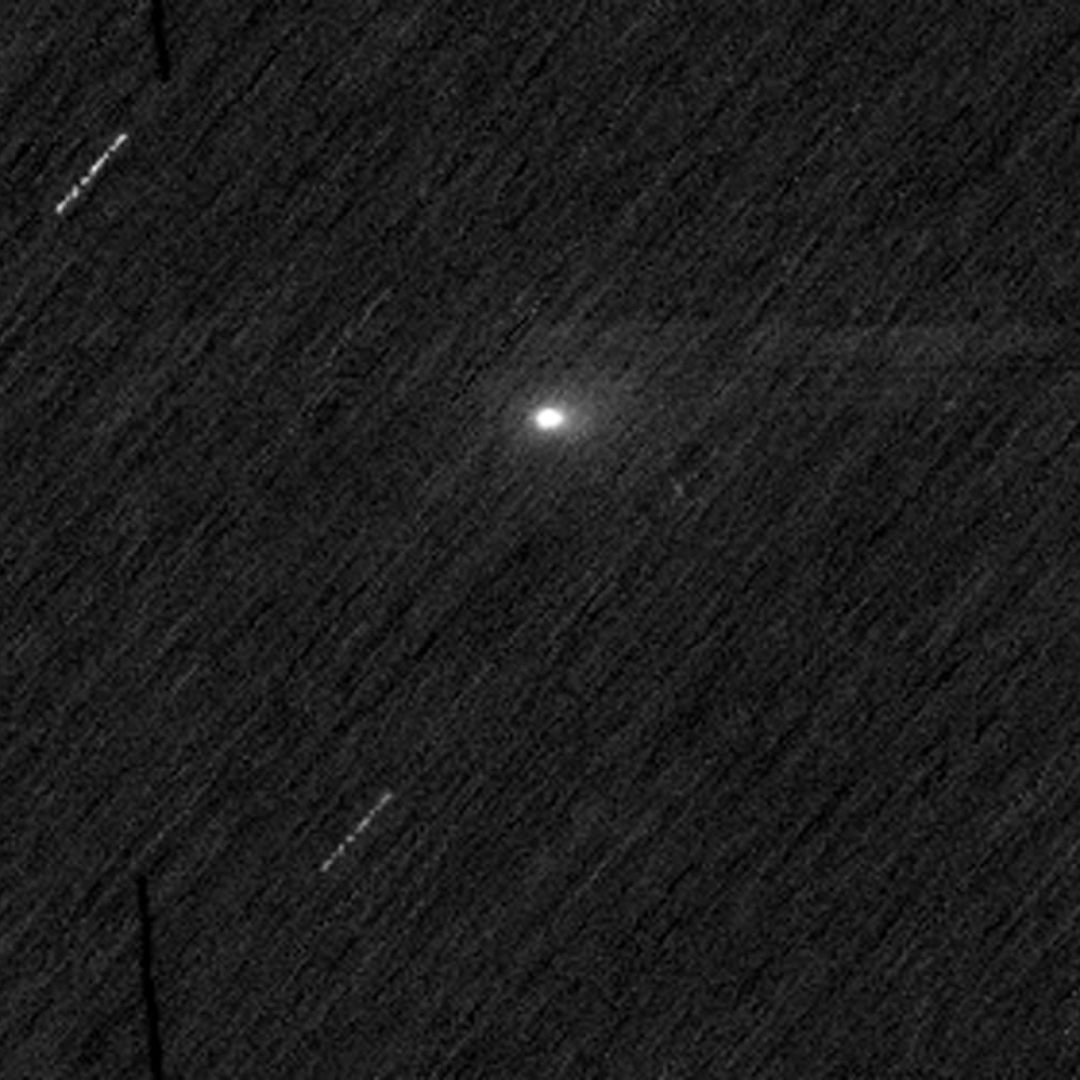
Astronomers confirm 3I/ATLAS (C/2025 N1) as the third known interstellar visitor after 1I/ʻOumuamua (2017) and 2I/Borisov (2019), discovered by the ATLAS survey on July 1, 2025. NASA projects perihelion around October 30, 2025, at ~1.4 astronomical units (AU) from the Sun, with no threat to Earth as the comet stays ~1.8 AU away at closest approach to our planet. The European Space Agency reports observations from Mars orbit: ExoMars Trace Gas Orbiter and Mars Express imaged the object as it passed near the Red Planet in early October 2025, providing unusually close views for an interstellar comet.
NASA’s Hubble Space Telescope imaged 3I/ATLAS on July 21, 2025, revealing a dust-rich coma around the icy nucleus when the comet was ~277 million miles (446 million km) from Earth. Recent analyses indicate vigorous water release at large heliocentric distances, with activity likened to a “fire hose,” suggesting volatile-rich material and offering clues about the chemistry of planetary systems beyond our own. Together, these datasets will help constrain the comet’s size, composition, and trajectory through the inner Solar System.